
Is GenAI just a Crutch or now an Adaptive Solution?
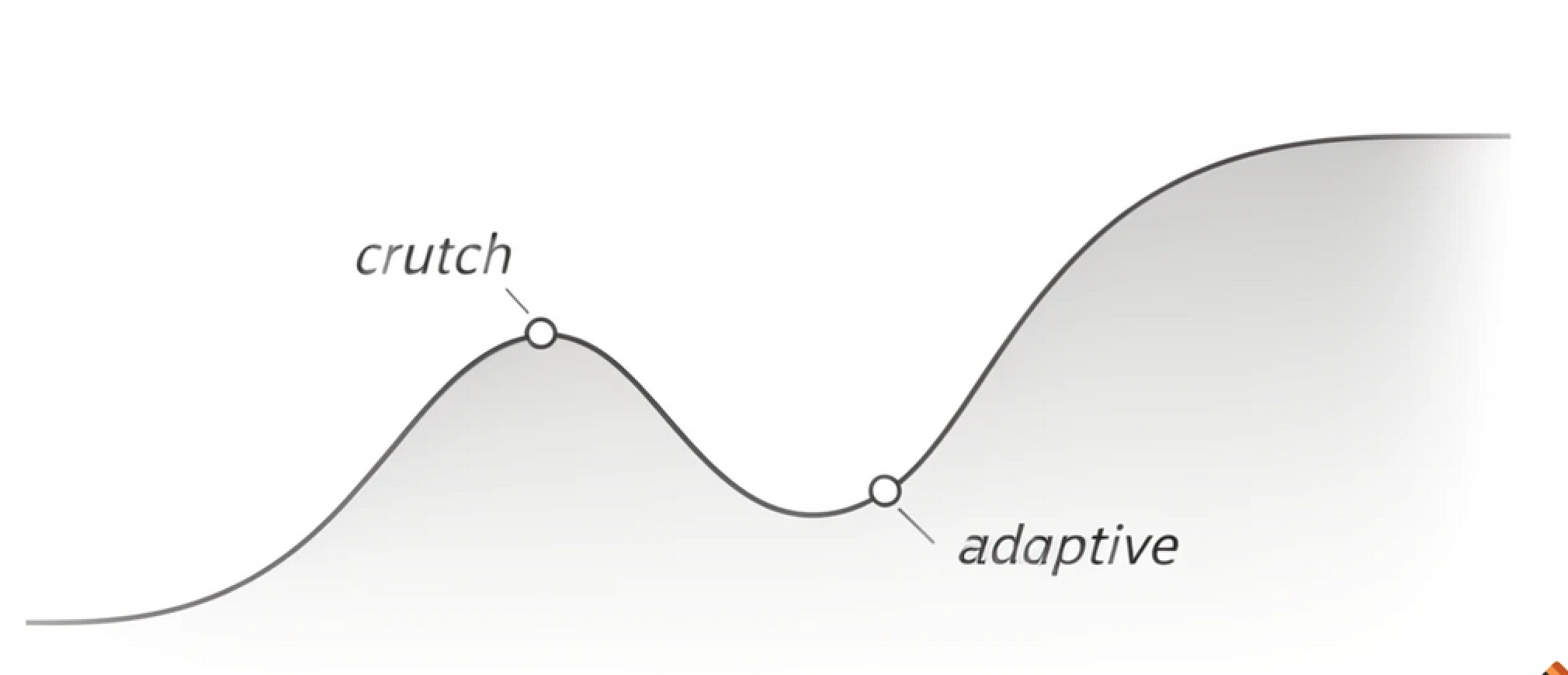
Our mental preconception of Artificial General Intelligence (#AGI) grabs our human-scale attention by the neurons and just yanks on it, promising a shiny science fiction future with smart robots, the end of manual labor and solutions to every problem. Of course, we’ve been here before with AI – it has never really landed. Is today’s AI all really just another cycle of overhype again?
I honestly don’t know, but I was writing an email today (to a potential client) complaining [1]all about the current marketing focus on AI by every company I talk to in every way possible, but something I drafted pulled me up short before I hit send. What stopped me short was that I had started declaring that one of the dangers of today’s GenAI might be that its rapid adoption is as much due to it being a crutch for certain skills like poor writing as anything else. And oh, that just sounded prejudicial, ableist and definitely not PC.
If you are a true AI believer, please forgive me as I had just read some social media pundits defending their heavy reliance on various #LLM based services in producing all their public facing content – posts, reports, social media, emails and so on. One of the defenses for AI-centric content production (which without heavy context priming and serious follow-up editing still reads to me as AI slop [2]) was that #genAI is not a crutch but an adaptive technology for those whom, for whatever challenges they face, don’t have inherent professional communication skills.[3][4]
So here is an opportunity for me to learn something and maybe correct my own ableist AI prejudices! So of course I had to first check in with Google Gemini for clarification:
Categorizing a behavior or tool as adaptive (a helpful support that builds capacity) versus a crutch (a dependency that hinders growth) comes down to its long-term impact on your autonomy and development.
Ok, that’s helpful, but as an example.. and this is key for a technology analyst…was the advent of the calculator a crutch or an adaptive solution? In hindsight, it does seem every technology that’s ever rolled out was intended to do something better (and with less skill), displacing what came before. New solutions might necessarily hinder growth in previous, underlying skillsets[5]. But then widely adopted tech always eventually seems to enable and unlock higher-level skills, shifting it broadly into the adaptive bucket. We now consider spreadsheets, dishwashers, credit cards, smartphones and self-driving cars adaptive, but they were all disruptive in their time.
A good question is if there is a defined transition we can observe (and hopefully as analysts predict) for when technology moves from crutch to adaptive?[6] We might visualize this as a point on a time-axis adoption curve roughly analogous to IDC’s hype cycle or the crossing of an evolutionary step along a kind of Wardley Map maturity axis.
Is genAI adopted today mainly as a crutch or as an adaptive solution? Of course we had to ask an AI about itself and of course it replied with the equivocal averaged insight that it’s both:
Generative AI can be both an adaptive technology and a crutch, depending entirely on how it is used.
So helpful! It went on to suggest that a crutch solution is one that is mainly used as a substitute, creates blind reliance, displaces both skills and discernment, and buries authentic “voice”. Whereas an “adaptive” solution is human-enabling via a cognitive offloading of low-level tasks, the quick up-leveling of insight, expanding the scope of operational capability, helping to avoid “writer’s block” through on-demand ideation[7] and fostering globalization because of its inherent translation of languages.
I do use AI “research” daily. Even in writing this post about it[8]. But through my old GenX cynicism, it still seems that vibe-coding, copy-writing, and many other of today’s touted LLM applications are mainly displacing experienced knowledge workers, creating tooling dependencies and enriching AI service providers more than they are elevating and empowering humanity, birthing new innovation or overall advancing society. Yet we do also see some glimmers of human enablement (the onslaught of AI slop and vibe-coded disasters-in-waiting aside, I know real people whom are feeling really AI empowered).
Our AI search savant then suggests that the core criteria between crutch and adaptive is keeping a human in-the-loop.[9] Based on that criteria, AI still seems kind of crutch today. Sorry all you want-to-get-rich-by-owning-all-the-AI-shovels AI investors! The idea of AI is shiny and sexy, but in practice its got a way to go before I’d score it solidly over in the “adaptive” category. Maybe we are fast approaching an AI watershed moment, a transition point between AI as a deskilling crutch versus AI as an adaptive, enabling tech. How will we really know when that happens? Going forward I’ll have to spend some serious analyst cycles diving into studying that transition – and also into the related question about how much should individuals, organizations and society then really invest and spend on AI and when. [10]
- Never really good to complain about the market to a prospect!??
- One questionable opinion I hold (which I am open to changing) is that those who haven’t developed writing as an inherent skill won’t achieve effectively better professional communication by relying on AI prompting and editing. Great prompting and editing require as much experience, knowledge and skill as direct writing — or else the AI result may be clean looking and smooth sounding but will still read as AI slop. Any intended communication can be superficially averaged out to the point where serious readers just skim past it. It’s never going to be a matter of convincing a target audience to just shut up, sit down, and read AI slop to find meaning. If anything, intelligent readers are already learning to use AI reading tools to skip past AI writing. If one desires to professionally communicate, tell an interesting story, and mind-meld with a target audience they need to be able to actually communicate (and here I am using a long dash, the Oxford comma, ending a sentence with a preposition and then tossing in an emoticon 🙂 ). ??
- I did think that those who choose to enter public discourse as a profession might consider clear communication to be a pre-requisite skillset. But if someone has valuable contributions to make, perhaps adaptive AI solutions open up the opportunity to reach a wider audience.??
- I can’t fly a plane, so I guess I chose not be a professional pilot. But now self-driving cars and even commercial trucks are a thing. Self-flying planes are not inconceivable. Maybe soon anyone can become an airline pilot – or will there always be a hard requirement for sober humans with inherent expert skills like multi-engine and IFR flying to be sitting in the cockpit???
- I have a lot of hobbies in legacy hands-on skills that have been displaced from common profession to the realm of arts & crafts. In my lifetime, professional skills like programming and driving cars will become niche and artisanal. “Artisting” does seems to be what people naturally migrate towards as they grow older (and increasingly displaced professionally).??
- If grade school classrooms on average currently prohibit some new tech, it’s probably still in its crutch stage. When it becomes commonplace in kindergarten, maybe we’d consider it maturing into an adaptive solution.??
- No, that’s not a meta meta comment. Or is it???
- Is that what irony is? I’m pretty sure it’s not just a fly in my chardonnay. One can’t help but use Google’s ubiquitous search bar without scanning the topline AI answer.??
- That must be why it seems every company is touting their adoption of AI with layoffs.??
- New datacenters, power generation and climate change would only be part of that equation. We need to reset societal expectations and standards, implement guardrails, shift educational goals, refactor employment, determine ownership and responsibilities, and far more.??